Medication safety
A genetic result needs a next step
Explaining the difference between a laboratory result and a useful prescribing decision.
THE QUESTION
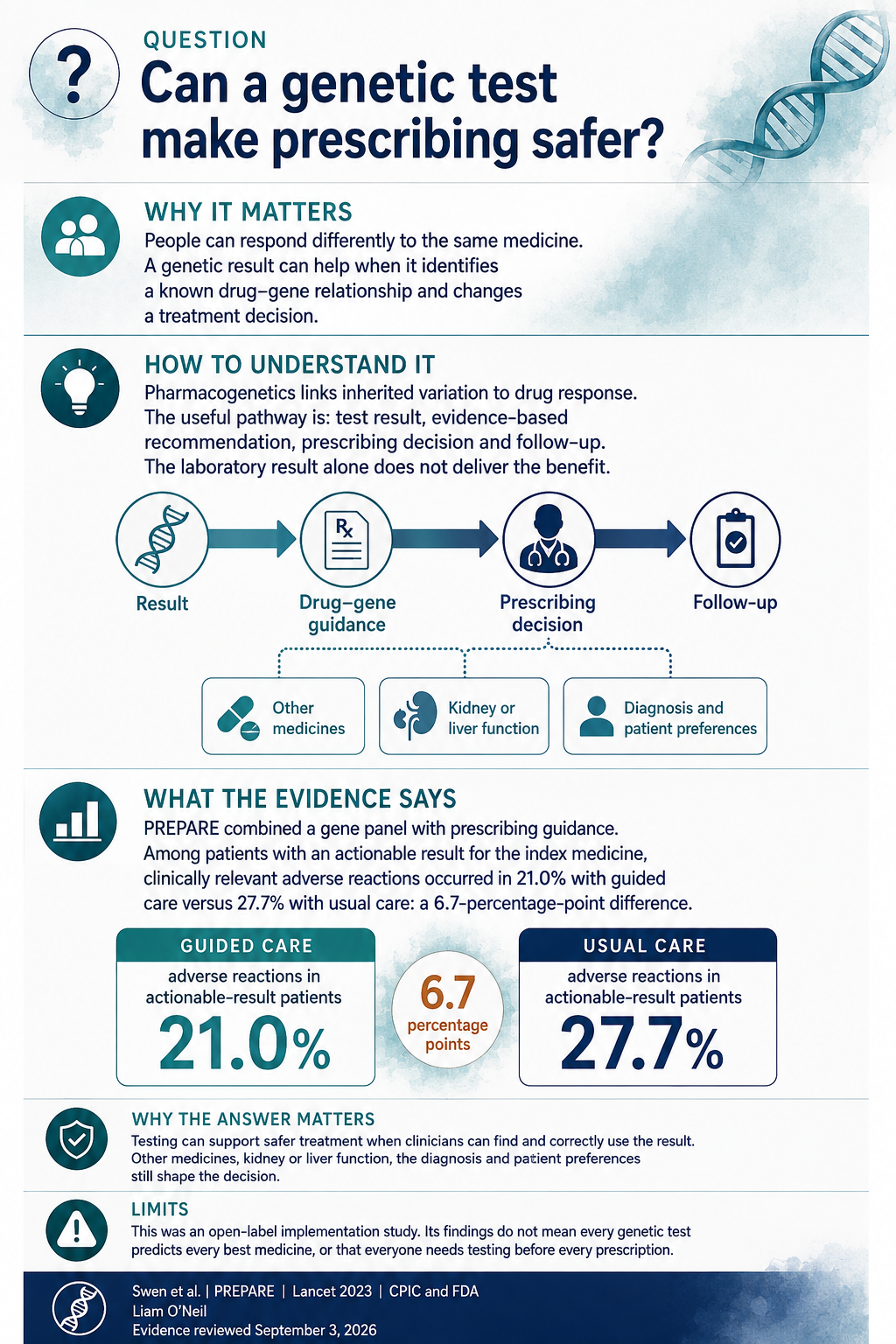
Can a genetic test make prescribing safer?
What the evidence says
PREPARE combined a 12-gene panel with prescribing guidance. Among patients with an actionable result for the index medicine, clinically relevant adverse reactions occurred in 21.0% with guided care and 27.7% with usual care: a 6.7-percentage-point difference.
How to read it
Pharmacogenetics connects inherited variation to drug response. Benefit depends on a relevant drug–gene relationship, access to the result, and appropriate use of prescribing guidance and follow-up.
Keep the context
This was an open-label implementation study. Other medicines, organ function, diagnosis and patient preferences still influence care. Its findings do not mean every genetic test predicts the best medicine or that everyone needs testing before each prescription.
Source behind the illustration
Swen et al. · The Lancet, 2023 · PREPARE implementation study ↗Educational communication of published evidence. Liam authored the illustration and explanation, not the cited study. No publisher or institutional endorsement is implied.
About the visual explanation
The central pathway gives the test a place in the clinical workflow. The numerical comparison uses percentage points explicitly and identifies the actionable-result population.
Collection methodology →Need to make a complex subject understandable?
Work with Us ↗