Translational science
A treatment designed for one patient
A single-patient report connects a rare metabolic disease with a specifically designed molecular intervention.
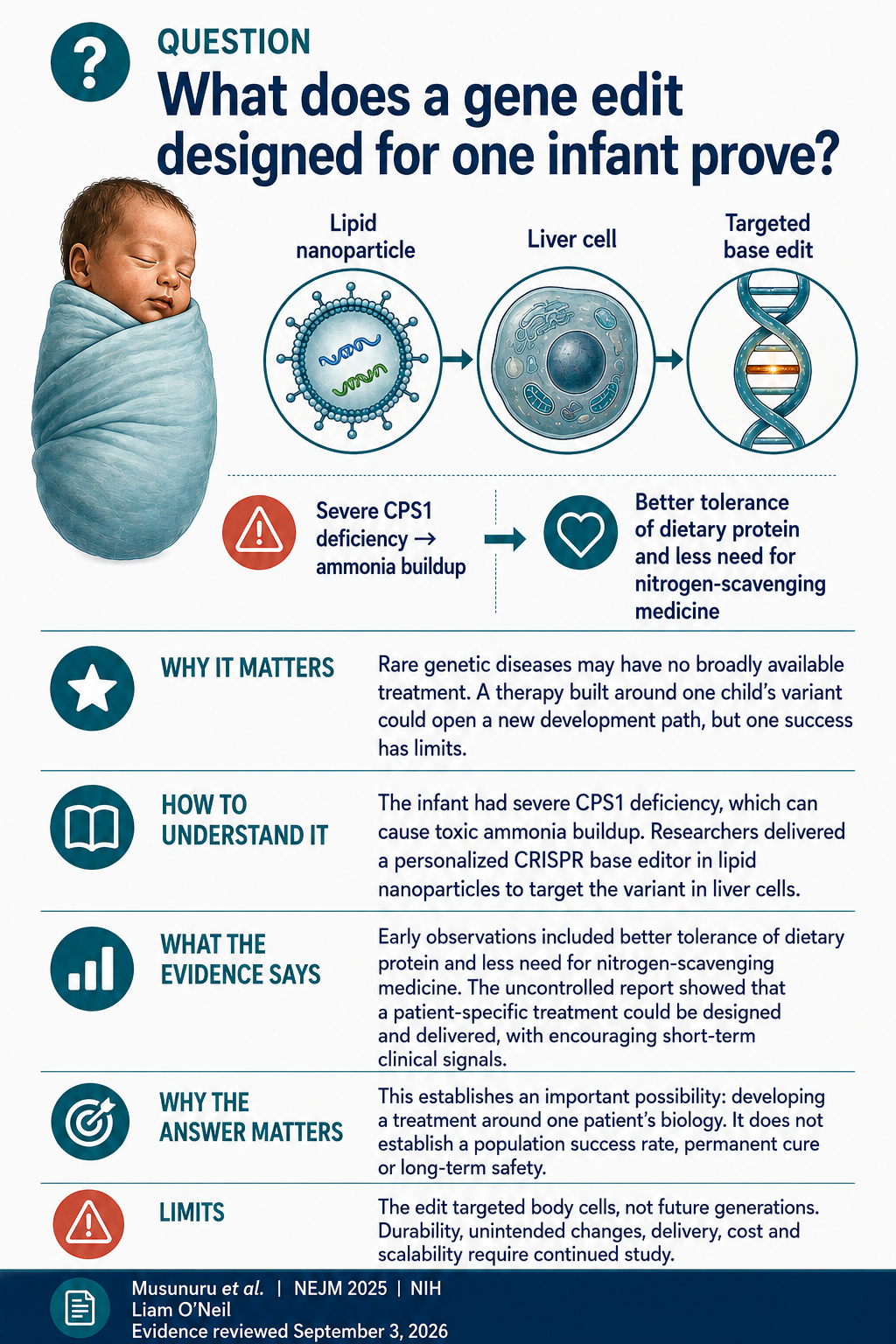
THE QUESTION
What does personalized gene editing make possible?
What the evidence says
A 2025 report described a personalized base-editing treatment for an infant with severe carbamoyl-phosphate synthetase 1 deficiency. The intervention used lipid nanoparticles to deliver editing components to the liver. The early clinical report described changes in protein tolerance and medication requirements following treatment, with continued observation.
How to read it
The report shows how a particular genetic change can guide the design of a treatment for one patient. The visual pathway helps distinguish the target, delivery system, and clinical response. It also makes the development problem visible: an intervention must reach the relevant cells and produce a useful effect, not merely be designed on a computer.
Keep the context
This is a single-patient experience with limited follow-up, not proof of a general cure or a standard treatment for other genetic conditions. Durability, safety, manufacturing, and access require further evaluation. Early improvement should remain separate from claims about lifelong benefit.
Source behind the illustration
Musunuru et al. · NEJM, 2025 · personalized gene editing ↗Educational communication of published evidence. Liam authored the illustration and explanation, not the cited study. No publisher or institutional endorsement is implied.
About the visual explanation
The composition moves from the patient to a delivery particle, the liver, and DNA. Each scale answers a different part of the same question.
Collection methodology →Need to make a complex subject understandable?
Work with Us ↗